Niche perfume often begins with curiosity: what might a memory, rain-soaked wood or an unexpected combination of familiar notes smell like? You do not need to memorise hundreds of names to explore it. Understanding the idea of niche, then taking time with a fragrance, is a more useful starting point.
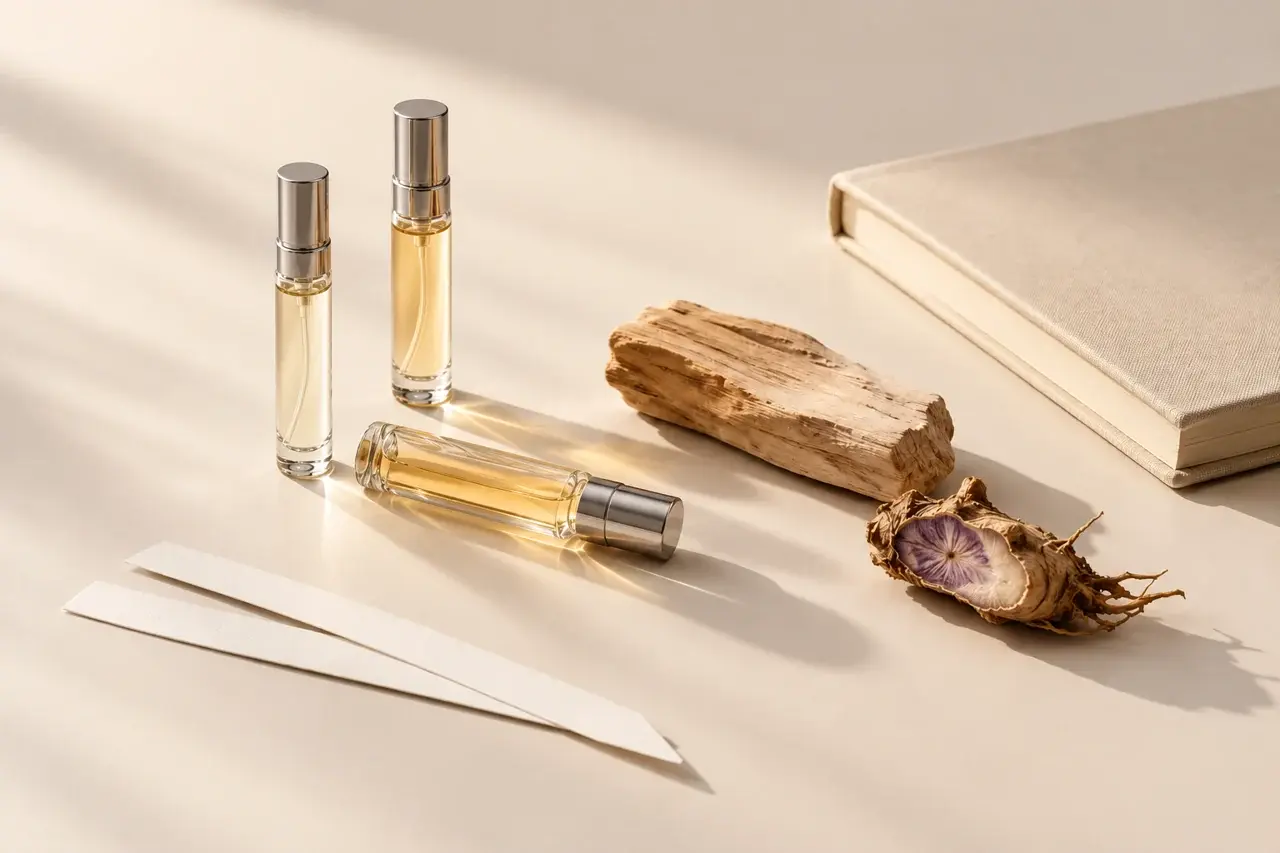
What does niche perfume mean?
The term commonly describes fragrances from houses whose main focus is perfumery, often with a distinctive creative identity rather than an aim to appeal to the broadest possible audience. It is a useful way to approach a brand, not a universal quality score for every bottle.
The boundary between niche and designer fragrance is fluid. A small perfume house can become international, while a fashion brand can create an adventurous collection. The category alone cannot tell you how a composition will feel to you.
The boundary between niche and designer fragrance is fluid. A small perfume house can become international, while a fashion brand can create an adventurous collection. The category alone cannot tell you how a composition will feel to you.
How the modern niche approach developed
Perfume houses have a long history, and modern niche perfumery has no single uncontested birthday. Individual creative approaches offer a more useful way to understand its development.
Jean Laporte founded L’Artisan Parfumeur in 1976. The house describes a tradition of creative freedom and inspiration from nature: one example of fragrance becoming an artistic statement in its own right. L’Artisan Parfumeur’s history.
Another important example is Editions de Parfums Frédéric Malle, founded in 2000. Its approach centred on working with outstanding perfumers and giving them creative freedom. These stories reveal niche as a collection of individual voices, rather than one particular style of scent. Frédéric Malle’s history.
How is it different from designer fragrance?
The brand’s focus. A perfume house usually tells its story primarily through scent. For a designer brand, fragrance belongs to a wider world of clothing, accessories and lifestyle.
The creative language. Niche houses often explore unusual combinations, textures and contrasts. Yet many make gentle, approachable scents, just as designer brands can create complex, experimental ones.
The discovery process. Comparing different directions and testing slowly is particularly helpful. A persuasive description or a high price cannot guarantee that a perfume will suit you.
Three myths worth leaving behind
“Niche always lasts longer.” Longevity depends on the particular formula, application and conditions of wear. A brand category does not promise a fixed number of hours.
“Niche means natural.” The word does not specify ingredients. Natural materials and synthetic molecules fulfil different creative roles, and a list of notes is not a complete ingredient list.
“You have to learn to love a difficult perfume.” Curiosity helps, but there is no need to force yourself to enjoy a scent that feels uncomfortable. Your taste matters more than a bottle’s reputation.
How to start exploring
Choose two or three directions that interest you: freshness, woods, flowers, soft powder or sweetness. Compare fragrances on blotters first, then return to favourites one at a time. Notice both the opening and the later stages in familiar surroundings.
Write down simple impressions: dry or sweet, airy or dense, quiet or noticeable. This is more useful than trying to identify every note. Think about comfort and the situations in which you would like to wear the fragrance.
Write down simple impressions: dry or sweet, airy or dense, quiet or noticeable. This is more useful than trying to identify every note. Think about comfort and the situations in which you would like to wear the fragrance.
Why start with a decant?
A decant is a small quantity of perfume transferred from its original bottle into a separate atomizer. It lets you explore a scent without buying a full bottle. It is not a different concentration or a promise of a different smell.
Explore the CraveScent decant collection to find a starting point. Read about CraveScent for more on our approach, and return to the journal for further guides and discoveries.
Explore the CraveScent decant collection to find a starting point. Read about CraveScent for more on our approach, and return to the journal for further guides and discoveries.
Where your own scent begins
A useful first question is not “Which perfume is the most niche?” but “What am I curious to experience?” A house’s history adds context; your own perception makes the final decision. Begin with a small discovery and leave room for surprises.
Two houses to explore in our collection: Matière Première — Vanilla Powder · Marc-Antoine Barrois — Ganymede.